

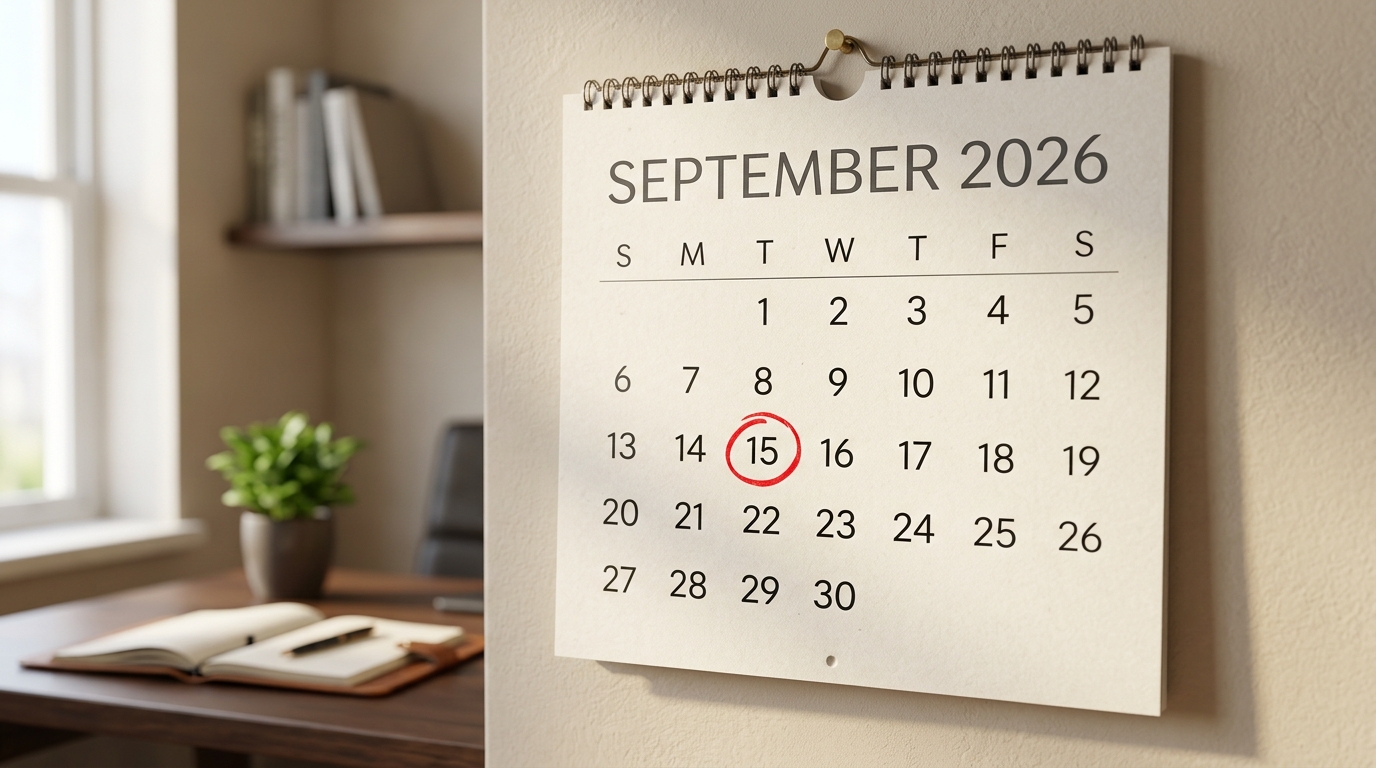
September has always felt like the month when life starts picking back up. Summer vacations are winding down, kids are back in school, and suddenly the end of the year doesn't feel quite so far away. For some taxpayers, September also brings another reminder: estimated tax payments are due September 15.
If you are self-employed, own a business, earn significant investment income, or receive income without taxes being withheld, you may have heard the term “quarterly taxes” before. But what exactly are they, who needs to pay them, and how much should you pay?
What Are Quarterly Taxes?
First, an important clarification: quarterly taxes aren't a separate type of tax. The U.S. tax system generally operates on a “pay-as-you-go” basis. If you work for an employer, taxes are typically withheld from each paycheck throughout the year. But if you receive income where taxes aren't automatically withheld, you may need to make estimated tax payments yourself. These payments can cover federal income tax as well as self-employment tax, which includes Social Security and Medicare taxes for people who are self-employed.
Estimated taxes are generally paid four times a year. For 2026, the payment deadlines are:
- April 15, 2026
- June 15, 2026
- September 15, 2026
- January 15, 2027
The dates aren't perfectly aligned with calendar quarters, which is one reason the term “quarterly taxes” can be a little confusing.
Who Needs to Pay?
You don't automatically owe estimated taxes just because you're self-employed or have investment income. Generally, you may need to make estimated payments if you expect to owe at least $1,000 in federal tax after subtracting your withholding and refundable credits, and you aren't on track to meet one of the IRS's safe-harbor thresholds.
People who commonly find themselves making estimated payments include:
- Freelancers and independent contractors
- Self-employed individuals and business owners
- People with substantial investment or capital gains income
- Individuals receiving income from rental properties
- Retirees with significant taxable retirement or investment income
- Anyone with other income that doesn't have enough tax withheld
And remember: you don't necessarily have to make a separate quarterly payment just because you have one of these types of income. For example, an employee who earns a side income might be able to increase the federal withholding from their paycheck instead.
So, How Much Should You Pay?
This is where things get interesting.
You could try to predict exactly how much you'll owe when you file your tax return next year. But unless you have a crystal ball, and Greyson just broke his or else I’d let you borrow it, that can be difficult.
Instead, the IRS provides safe-harbor rules that can help taxpayers avoid an underpayment penalty.
Generally, you can avoid the federal estimated-tax penalty if your withholding and estimated payments equal at least the smaller of:
90% of your current year's tax liability
OR
100% of your prior year's tax liability
For higher-income taxpayers, the prior-year threshold generally increases to 110% if adjusted gross income was more than $150,000 ($75,000 for married taxpayers filing separately). Here's a simplified example.
Let's say your total federal tax liability for 2025 was $20,000. For 2026, you expect your income to increase and think you'll owe around $25,000. Rather than trying to perfectly predict that $25,000, you could potentially use the prior-year safe harbor. If the 100% threshold applies, you would want at least $20,000 paid through withholding and estimated payments during 2026. If you're dividing that amount into four equal payments:
$20,000 ÷ 4 = $5,000 per payment
If the 110% threshold applies to you:
$20,000 × 110% = $22,000
That would mean approximately $5,500 per payment if divided evenly across four payments.
But There's an Important Catch! Meeting the safe harbor doesn't necessarily mean you won't owe money when you file your tax return. It simply helps protect you from an underpayment penalty. Think of it as the difference between paying enough throughout the year to satisfy the IRS's requirements and actually paying your final tax bill. You could meet the safe-harbor requirement and still owe additional taxes when you file. Conversely, you could pay more than necessary throughout the year and receive a refund. The goal of estimated payments is to get your payments reasonably close to your actual tax liability while avoiding an unpleasant surprise, or penalty, at tax time.
What If Your Income Changes During the Year?
This is particularly important for people whose income isn't consistent. Maybe you're self-employed and your business has a slow spring but a very strong summer. Or perhaps you sell an investment and realize a large capital gain. Your income may not arrive evenly throughout the year, so blindly dividing your expected annual tax bill into four equal payments isn't always the best approach. The IRS allows taxpayers with uneven income to use an annualized income installment method, which can take the timing of your income into account when calculating estimated payments.
This can be especially relevant for business owners, investors and anyone with significant fluctuations in income.
How Do You Actually Make a Quarterly Payment?
You have several options. Estimated payments can be made electronically through the IRS's payment systems, or you can mail a check or money order using the payment vouchers included with Form 1040-ES. You can also make payments through your IRS online account. And you don't necessarily have to send four separate checks. The IRS notes that you can make payments more frequently—weekly, biweekly or monthly, for example—as long as you've paid enough by the applicable quarterly deadlines.
Don't Let September Sneak Up on You
If you receive income without tax withholding, September is a good time to pause and ask yourself a few questions:
Has my income changed significantly this year?
Have I had a large investment gain or other unexpected income?
How much federal tax have I already paid through withholding and estimated payments?
Am I on track to meet one of the IRS safe-harbor thresholds?
If you're not sure, don't guess. Form 1040-ES provides a worksheet for estimating your tax, and your tax professional can help you determine whether your current payments are sufficient. Estimated taxes may not be the most exciting part of September, but understanding them can help you avoid one of the least-fun surprises in personal finance: discovering that you owe the IRS and a penalty for not paying enough along the way.
A little planning now can make April a whole lot less stressful.
Enjoy the rain and taxes!
Chandler